
// The Creator Economy · 2026
Internet Chicks in 2026: How Women Creators Really Earn, Grow and Get Paid
An internet chick is a woman who has built real visibility and influence online, as a creator, streamer, educator, or founder. This guide covers how the business actually works: the platforms, the algorithms, the money, and the legal rules nobody talks about.
Free to read · No sign-up · Updated for 2026
- 207Mpeople creating content online
- 64%of those creators are women
- $249Bcreator economy value in 2026
01 · The definition
A woman who turned attention into a working asset.
Not a follower count. An asset. One that pays rent, funds a team or replaces a salary she walked away from.
02 · The numbers
- 207Mpeople create content online
- 64%of them are women
- $249Bcreator economy value in 2026
03 · The difference
The gap isn’t follower count. It’s ownership.
An influencer rents distribution. A digital creator builds a channel she controls: a list, a Discord, a paid community.
Your turn
Where do you want to start?
Internet Chicks vs. Traditional Influencers: What's the Difference?
The gap isn’t follower count. It’s ownership.
A traditional influencer rents distribution. The platform decides who sees the post, the brand decides the fee and one algorithm update can erase both. A digital creator builds a channel she controls — a list, a Discord, a paid community, and treats social platforms as the top of a funnel rather than the whole business.
Snapchat shows that dynamic plainly: the app itself decides who counts as a creator’s closest friends and a guide to Snapchat Planets lays out exactly how that order gets assigned.
| Factor | Traditional Influencer | Digital Creator |
|---|---|---|
| Content Approach | Follows whatever is trending this week | Owns one narrow subject and goes deep |
| Monetization | Brand fees, one invoice at a time | Four or more streams running in parallel |
| Audience Relationship | Talks at a crowd | Knows names, answers replies, runs a community |
| Longevity | Survives only while the feed cooperates | Holds an email list nobody can throttle |
| Brand Identity | Personality carries the whole thing | Repeatable format, visual system, clear promise |
Money follows that difference. Brand fees stall when engagement dips. A course library, a paid newsletter or a coaching roster keeps earning through a bad quarter.
The History and Evolution of
Internet Chicks
Twenty years separate a Blogspot template from a limited liability company. The route ran through four distinct eras, and each one changed what a woman needed in order to get paid.
1995–2005 Early Internet Era: Blogs, Forums, and the First Wave
No feed. No recommendations. If a stranger read your writing, another human had linked to it.
Women built readerships on LiveJournal, Xanga, Diaryland and a thousand phpBB forums. Distribution came from blogrolls, webrings and comment reciprocity, which meant the currency was reliability. Post every Tuesday for two years and a few hundred people would show up every Tuesday. Money was thin, a BlogAds banner, a PayPal tip button, an Amazon Associates link at the bottom of a book post. Nobody quit a job over it. Plenty learned HTML, headline writing and audience patience that later turned out to be the whole skill set.
2006–2015 Social Media Explosion: Visual Content Takes Over
YouTube opened in 2005. Instagram followed in 2010. Between them they moved the medium from paragraphs to faces.
Beauty tutorials proved the model first. A woman with a webcam, a ring light and a repeatable format could out-reach a magazine section, and brands noticed the comment threads before they noticed the traffic. Ad revenue arrived through AdSense. Sponsored posts arrived through agencies who had no idea what to pay. PR gifting arrived by the boxful. The women who learned to edit early, actual cuts, actual pacing , kept a lead that lasted most of a decade.
2016–Present The Creator Economy Era: From Followers to CEOs
TikTok broke the follower requirement. A first video could out-perform a channel with two million subscribers, because the system tested content instead of reputation. Twitch turned live play into a subscription business. Substack proved that long-form writing still had a paying market, and it now carries around 5 million paid subscriptions with roughly 100,000 publications earning money.
What changed most wasn’t reach. It was infrastructure. Stripe, Gumroad, Kit, Teachable and Podia let one person sell a $200 product on a Sunday without a developer, a warehouse or a distributor. That’s the shift that made “creator” a job title instead of a hobby description.
| Era | Key Platforms | Primary Format | Revenue Source |
|---|---|---|---|
| 1995–2005 | Blogs, forums, LiveJournal | Text | Banner ads, tip jars, early affiliate |
| 2006–2015 | YouTube, Instagram, Tumblr | Video, photos | AdSense, sponsored posts, gifting |
| 2016–2022 | TikTok, Twitch, Patreon | Short-form video, live | Creator funds, subscriptions, merch |
| 2023–Present | Fragmented, plus owned channels | Mixed, AI-assisted | Products, memberships, services, licensing |
The trajectory is clear. These women went from hobbyists to full-scale digital entrepreneurs running empires from their laptops.

Where Internet Chicks Build
Their Empires
and you’ll spend a year learning that the hard way.
1.99B+ TikTok — Where an Idea Gets Tested First
TikTok reached roughly 1.99 billion monthly users by January 2026 and it still treats a new account and a huge account as equals on the first push. The system reads completion rate, rewatches, shares and comment velocity, then decides whether video two gets a wider test.
That makes it the fastest place on the internet to find out whether an idea works. It’s also the weakest per view. Growth here is cheap. Revenue isn’t.
Format: Short vertical video. Best for: Testing hooks, finding a niche, building reach from zero.
2.58B+ YouTube — Work That Still Earns in Three Years
Around 2.58 billion people use YouTube monthly, and it behaves less like a feed than a search engine with a recommendation layer bolted on. A tutorial published in March can still deliver traffic three years later.
Pay reflects that. RPM ranges by subject from about $0.50–$4 per thousand views in gaming up to $5–$20 in personal finance. Same effort, ten times the return, depending entirely on who advertises against your topic.
Format: Long video, Shorts, live. Best for: Compounding search traffic and the highest ad rates.
3B+ Instagram — Where the Brand Money Still Lives
Instagram crossed 3 billion monthly users and still holds the largest brand budgets, mostly because marketing teams have been buying there for over a decade. Reels handle discovery. Stories handle the relationship. The grid is a portfolio a brand manager checks before sending a contract.
Saves and sends now matter more than likes. A post nobody likes but three thousand people save is a hit.
Format: Reels, carousels, Stories. Best for: Landing paid partnerships and looking credible to buyers.
240M+ Twitch — Smallest Room, Deepest Loyalty
Twitch counts roughly 240 million monthly users. Small next to the video giants, disproportionately loyal because the interaction is live and unedited.
The economics are blunt. Standard subscription revenue splits 50/50. Reaching 60/40 takes 100 recurring paid subs held for three straight months, and the 70/30 tier requires 300 Plus Points across three months. Gifted and Prime subs don’t count toward either. Amazon removed the old $100,000 ceiling on the better split, which helped, though only a small share of partners ever qualify.
Format: Live streams, clips, VODs. Best for: Recurring subscription income and a community that shows up daily.
50M+ Substack — The One List Nobody Can Throttle
Substack now carries about 50 million active subscriptions, 5 million of them paid, across more than two million publications. Writers grossed $450 million there in 2025, up from $370 million the year before.
No algorithm stands between a writer and her readers. Average open rates run near 44%, roughly double typical email marketing. Substack takes 10% of paid subscription revenue plus processing. Growth is slow. Revenue per reader beats everything else on this list.
Format: Email, essays, podcast, video. Best for: Audience ownership and the highest lifetime value per subscriber.
Platform Comparison Table
Understanding where this movement started reveals why it carries so much weight today.
| Platform | Audience Size | Content Type | Best Growth Speed |
|---|---|---|---|
| TikTok | 1.99B monthly users | Short vertical video | Very fast, low pay per view |
| 3B monthly users | Reels, carousels, Stories | Medium, strongest brand budgets | |
| YouTube | 2.58B monthly users | Long video, Shorts | Slow, earns for years |
| Twitch | 240M monthly users | Live streams | Slow, deepest loyalty |
| Substack | 50M subscriptions | Written, audio, video | Slow, highest revenue per reader |
Types of Internet Chicks: Who's
Actually Out There?
Personality quizzes miss the point. What matters is the map between what a woman makes,
where she posts it and how the money reaches her account.

01 Lifestyle & Fashion Creators
The most crowded category and the most misread. Outsiders see outfit videos. The actual job is running a consistent visual identity across hundreds of assets so a brand can predict exactly what it’s buying.
Rates here move on engagement, not headcount. A 40,000-follower account with a tight aesthetic and a 6% engagement rate routinely out-earns a 300,000-follower account that bought its growth in 2021.
Tech & Software Creators
Highest ad rates, longest shelf life, smallest competition among women. A clear walkthrough of a spreadsheet function or an AI tool ranks for years and pulls $4–$12 RPM while a beauty video of the same length pulls a quarter of that.
The barrier is credibility, not equipment. Ship something, explain it plainly, show your screen.
Gaming & Esports Streamers
Twenty to forty hours of live output a week, with moderation running the entire time. Women in this category build the tightest communities on the internet and absorb the worst chat behavior on it, which is why the successful ones invest in mod teams before they invest in a better camera.
Subscription income is recurring, which makes it the most predictable money in creator work, once the base exists.
Educators & Knowledge Creators
Teaching converts better than anything else because the audience arrives already wanting to pay for an outcome. A nurse explaining pharmacology, an accountant explaining quarterly taxes, a developer explaining Rust, each can sell a course to a few hundred people and clear more than a lifestyle creator with fifty times the reach.
Authority stacks. Every good explanation makes the next sale easier.
Digital Entrepreneurs
Here the content isn’t the product. It’s the marketing department for a product that already exists: a SaaS tool, an agency, a physical line, a booking calendar.
These women often have the smallest audiences and the largest revenue, because a thousand right-fit readers who buy a $400 offer beat a million passive viewers.
Fitness & Wellness Creators
Trust is the whole business here and it’s fragile. A single unqualified claim can cost an entire audience. The ones who last stay inside their credentials, show their own progressions honestly and sell programming rather than transformation promises.
Retention is exceptional when the coaching actually works. Clients renew for years.
Challenges Internet Chicks
Face in 2026
Every honest account of this work includes the parts nobody films.
Mental Health and Burnout
The output never ends. There’s no finished, no shipped, no quarter closed. Just the next post, and the awareness that skipping a week costs reach you’ll spend a month rebuilding.
Comment sections make it worse. Ninety-nine supportive replies and one cruel one, and the cruel one is the one that follows you to bed. Creators who last build hard structures around this: fixed publishing days, batched recording, a mod who filters the inbox, and stretches of genuine time off booked before the calendar fills.
Income Instability and Algorithm Dependence
One platform change can cut reach in half without warning or explanation. No notice, no appeal, no support ticket that reaches a human.
That’s the argument for diversification, and it isn’t theoretical. A creator earning entirely from brand deals has one customer type and zero leverage. A creator running ad revenue, affiliate income, a product and a membership can lose any single stream and still make rent. Building the second stream while the first one is healthy is the whole trick, almost nobody does it, because the first one feels fine right up until it doesn’t.
Online Harassment and Privacy Threats
Women in public online absorb a category of abuse men mostly read about. Doxxing, coordinated mass-reporting, image theft, stalking that crosses into physical space.
Defense is unglamorous. Scrub location metadata out of photos before they go up. Register the business to an agent’s address, never the flat you sleep in. Route PR packages through a mailbox service. Check what sits behind you in frame, a street sign, a delivery label or a view through a window has identified more than one creator. Swap SMS codes for a hardware key. Keep a recovery address nobody has ever seen.
Platform reporting is slow and wildly inconsistent. Document everything and find out which authority handles this in your country before the week you need them.
Societal Criticism and Double Standards
A man who monetizes an audience is an entrepreneur. A woman who does the same gets asked whether it’s a real job.
The scrutiny is specific: her appearance, her tone, whether she’s “authentic,” whether her partner minds, whether she’s a good mother. Male creators in identical niches field none of it. The double standard doesn’t reduce her income. It does add an invisible tax of emotional labor to every public decision she makes.
The Future of Internet Chicks:
What Comes Next
Three shifts are already underway. None of them are predictions.

AI-Powered Content Creation
Editing that took six hours takes ninety minutes. Captions, cuts, transcripts, thumbnails and repurposing across four formats now run mostly on tooling.
That drops the cost of production toward zero, which floods every feed. The consequence isn’t that AI wins. It’s that volume stops being a differentiator and trust becomes the only scarce thing left. Brands have started writing “human creator” clauses into contracts. Platforms have started labeling synthetic content. A verifiable track record, a real face and accountability when a recommendation goes wrong are the four things a model still can’t supply.

Virtual Reality, Augmented Reality, and Immersive Content
Headset adoption is still small. The creators experimenting now are buying option value, not income. Virtual fitness classes, walkthrough spaces and AR try-on tools all work technically. Audiences haven’t followed at scale.
Worth watching, not worth betting a business on. The women who moved to YouTube in 2007 looked early and reckless for about three years.

Greater Diversity and Global Representation
The next wave isn’t coming from Los Angeles. It’s coming from Lagos, Jakarta, São Paulo, Karachi and Manila, in languages that have never had a creator middle class before.
Cheap phones, cheap data and native-language monetization changed the math. Brands chasing those markets need creators inside them, which is redirecting real budget away from the accounts that dominated the last decade.
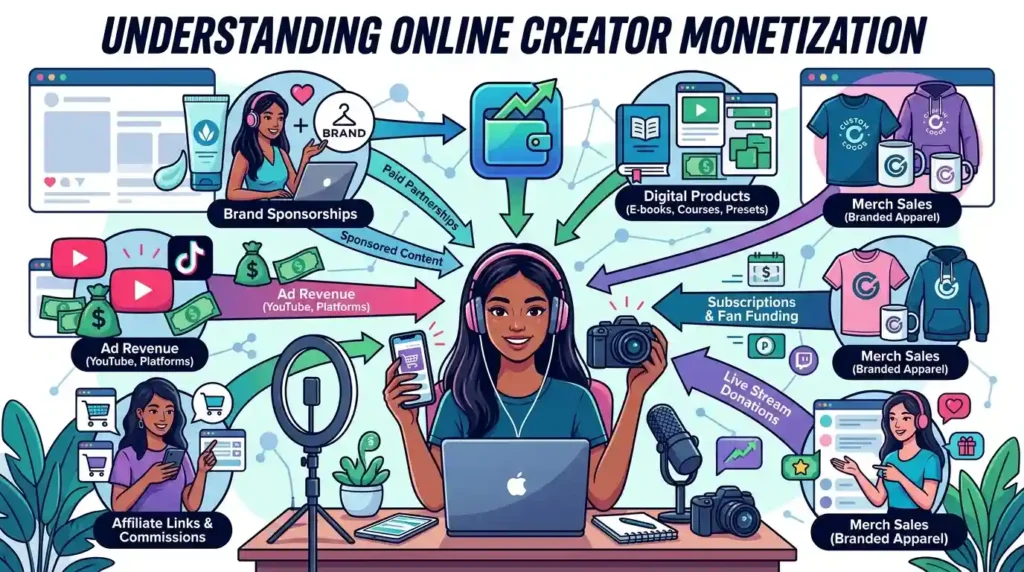
Influence pays nothing on its own. It pays when it gets attached to a mechanism. Most women earning a full-time
living run four or more of these at once, and the mix matters more than any single line item.
Brand Deals and Sponsorships
A company pays for placement. Simple in theory, messy in practice.
Rates move on engagement, niche and usage rights, not follower count alone. Adding paid amplification rights or exclusivity can double a fee. Read the terms everyone skips. Invoices settle on thirty-day terms at best, and sixty or ninety days is routine once a brand is large enough to make you wait. If an agency manages you, another 15% to 20% disappears before the money lands.
Platform Comparison Table
| Platform | Followers | Rate Per Post |
|---|---|---|
| 10K–100K | $100–$5,000 per post | |
| 100K–500K | $5,000–$10,000 per post | |
| YouTube | 100K–500K | $10,000–$20,000 per video |
| TikTok | 100K–500K | $1,250–$2,500 per video |
Figures follow Meltwater’s 2026 rate benchmarks. Treat them as a floor for negotiation, not a ceiling.
The gatekeepers didn’t lower the barrier. They lost the gate. A woman with a phone, a specific subject and eighteen months of consistency can now build something that used to require a publisher, a studio and somebody’s permission.
Affiliate Marketing
Commission on tracked links. Low effort once the content exists and it compounds. A review published two years ago still pays when someone finds it through search.
Works best where purchase intent is already high. Software, tools, equipment. It works badly on impulse categories where nobody comparison-shops.
Digital Products
Courses, templates, presets, ebooks. High effort upfront, close to zero marginal cost afterward, and the ceiling is higher than anything else on this list.
Fees stack, though. Selling through Gumroad costs a flat 10%, and card processing skims a further 2.9% plus thirty cents off every single sale.
Memberships & Subscriptions
The most stable creator income there is. Patreon moved every new creator to a flat 10% platform fee on August 4, 2025, with legacy plans grandfathered at 5%, 8% and 11%. Add processing at 2.9% + $0.30 plus a $0.25 payout charge and the real take lands closer to 14–16%, depending on tier price.
Substack charges 10% of paid subscriptions and nothing else. YouTube Memberships sit inside the platform’s own split.
Coaching & Consulting
Highest hourly rate, zero scalability. Trading hours for money with a hard ceiling. But it needs the smallest audience of any option, and it’s the fastest path to first revenue for anyone with a genuine credential.
Many creators use coaching to fund the year it takes to build a product, then wind it down.
The barrier to entry is gone. The new barrier is purely
creative endurance.
Tools Internet Chicks Use Daily
Four categories cover almost everything: something to edit with, something to design with, something to measure with
and something to schedule with.
Content Creation Tools
| Tool | Purpose | Cost |
|---|---|---|
| CapCut | Mobile video editing | Free |
| Adobe Premiere Pro | Professional editing | Paid |
| Canva | Graphic design, thumbnails | Free/Paid |
| DaVinci Resolve | Advanced editing | Free/Paid |
| Descript | Podcast and video editing | Paid |
Analytics & Performance
public growth history for any channel, useful for sizing competitors
YouTube keyword research, thumbnail A/B testing, bulk edits
where blog and link-in-bio traffic actually comes from
audience quality and fake-follower detection
cross-platform reporting for creators managing several accounts
Scheduling & Automation
straightforward queueing across most major networks
visual grid planning built around Instagram
email sequences, tagging and product delivery
scheduling plus competitor benchmarking in one dashboard
Understanding the Algorithms:
How Content Gets Discovered
Nobody publishes the source code. Every platform does publish the signals it weighs.
Those are enough to work with.
Discovery Engine
Discovery Engine — How TikTok's Algorithm Pushes Content
TikTok judges each video on its own. Follower count barely enters the calculation on the first push.
The system samples a small audience, then watches completion rate, rewatches, shares, comments per view and whether people tap the sound. Strong signals earn a wider test. Weak ones stop the video cold, regardless of who posted it. That’s why a dormant account can wake up with four million views and why a reliable channel can post a dud with no explanation.
Practical read: the first two seconds decide the completion rate, and the completion rate decides everything else.
Search Play
Search Play — How YouTube SEO Works
YouTube is a search engine wearing a recommendation feed. Two-thirds of the work happens before you hit publish.
It weighs click-through rate, average view duration, session time, keyword placement in the title and description, and thumbnail contrast. A title matching real search demand plus a thumbnail that wins the click plus a first minute that holds attention. Those three, in that order. Everything else is decoration.
The payoff is durability. A video that ranks keeps earning for years, which is the only place in creator work where past effort still pays.
Algorithm Transparency vs. Content Selection Bias
Here’s the part platforms don’t advertise. Organic reach shrinks on purpose, because paid distribution is the product being sold. Ranking systems reward strong reactions, which quietly penalizes anything measured or nuanced. Polished production often outranks honest, unpolished work even when the unpolished version is more useful.
None of it is fixable from where you’re sitting. The way out is a channel you own outright: a list, a community, a site with your name on the domain.
Numbers are a rearview mirror. Precise about a road you’ve already driven, silent on the turn ahead. What to make next, and who it’s for, stays a judgment call.
Anyone researching creators eventually needs harder data than a curated gallery provides. Two tools do most of that work.
Social Blade — Raw Analytics Powerhouse
Social Blade tracks public growth history across YouTube, Twitch, Instagram, TikTok and X. Free, no account required, and honest about what it can’t see.
It’s the fastest way to check whether a channel is actually growing or coasting on a spike from eighteen months ago. What it won’t tell you: audience demographics, engagement quality or whether those followers are real.
Social Blade
Primary Focus
Deep numerical analytics
Content Display
Charts and graphs
Target Audience
Data analysts, marketers
Internet Chicks● the edge
Primary Focus
Curated visual content discovery
Content Display
Multimedia content galleries
Target Audience
Fans, digital creators
HypeAuditor — Fraud Detection and Audience Demographics
HypeAuditor answers the question Social Blade can’t: are those followers people? It scores audience quality, flags suspicious growth patterns and breaks down age, gender and location.
Brands use it before signing contracts. Creators use it before quoting a rate. A clean audience-quality score is leverage in a negotiation. A bad one explains why a pitch went quiet.
creator profiles analyzed
Privacy, Safety, and Legal Realities
The digital landscape demands serious security. You can’t ignore this section. If you are a new creator wondering about platform privacy and security, read our comprehensive guide on is Internet Chicks safe.
How Platforms Handle User Privacy
Any discovery platform worth trusting does four things:
no data gathered without a stated purpose for it
Industry-standard methods shielding profiles from unauthorized access
vague language usually hides something specific
removal that actually removes, not a form that goes nowhere
Intellectual Property and Content Attribution
Two mistakes cost creators the most money.
The first is music. Platform-licensed audio does not carry over to sponsored content. A track that’s free on a personal Reel turns into a licensing violation the moment that post becomes an ad. Rights holders do pursue it.
The second is disclosure. The FTC updated its Endorsement Guides in June 2023, and the standard is unambiguous: if you were paid, gifted or you earn commission, say so clearly and up front. That means “#ad” at the start of a caption rather than buried in a hashtag block, spoken disclosure in video rather than on-screen text alone, and disclosure on affiliate links too. Free product counts as compensation.
Attribution runs both directions. Credit the creators whose work you feature, register original work that matters, and file business paperwork under a registered agent rather than a home address.

Control over your own data is the last thing anyone will hand you voluntarily. Take it yourself. Own the list, own the checkout, own the archive.
Frequently Asked Questions
What does "internet chicks" mean?
How do internet chicks make money?
Which platform is best for internet chicks starting?
How are creators selected on internetchicks platforms?
Selection varies by site and most are vague about it. Credible directories publish their criteria — consistent output, verified account ownership, real engagement, a clear niche — and separate editorial picks from paid placements. If a site won’t say how a creator got listed, treat the list as advertising.
Is browsing internetchicks content free?
How do internet chicks platforms handle privacy?
What are the best alternatives to internet chicks?
Social Blade for public growth history, HypeAuditor for audience quality and fraud detection, Modash for brand-side creator search, and each platform’s own analytics for anything about your own account. Together those cover roughly everything a creator or a marketer actually needs.
Does the platform work on mobile devices?
Internet chicks aren't a passing
trend.
They rebuilt the pipeline. Audience, distribution, product and payment now sit inside one person’s control. The women who worked that out first are running businesses that would have needed a publisher, a studio and somebody’s boardroom fifteen years ago.
The numbers keep pointing the same direction: a market near a quarter of a trillion dollars, 207 million people working in it, most of them women. What’s actually interesting isn’t the size. It’s that the barrier moved from access to consistency. Anyone can publish. Almost nobody keeps going long enough for it to compound.
Nobody wins this on talent. The women still standing in year three won by showing up on the weeks it felt pointless, and by earning a few thousand readers who actually believe them.